


November 14: Whales, Wonders, and Worlds Beyond
From the depths of imagination to the heights of human achievement, November 14 marks a celebration of curiosity, courage, and perseverance. On this day, a novelist redefined storytelling, a reporter redefined possibility, and a pair of astronauts redefined exploration. Together, they remind us that the spirit of discovery knows no limits—only horizons waiting to be crossed.
A Literary Leviathan Rises
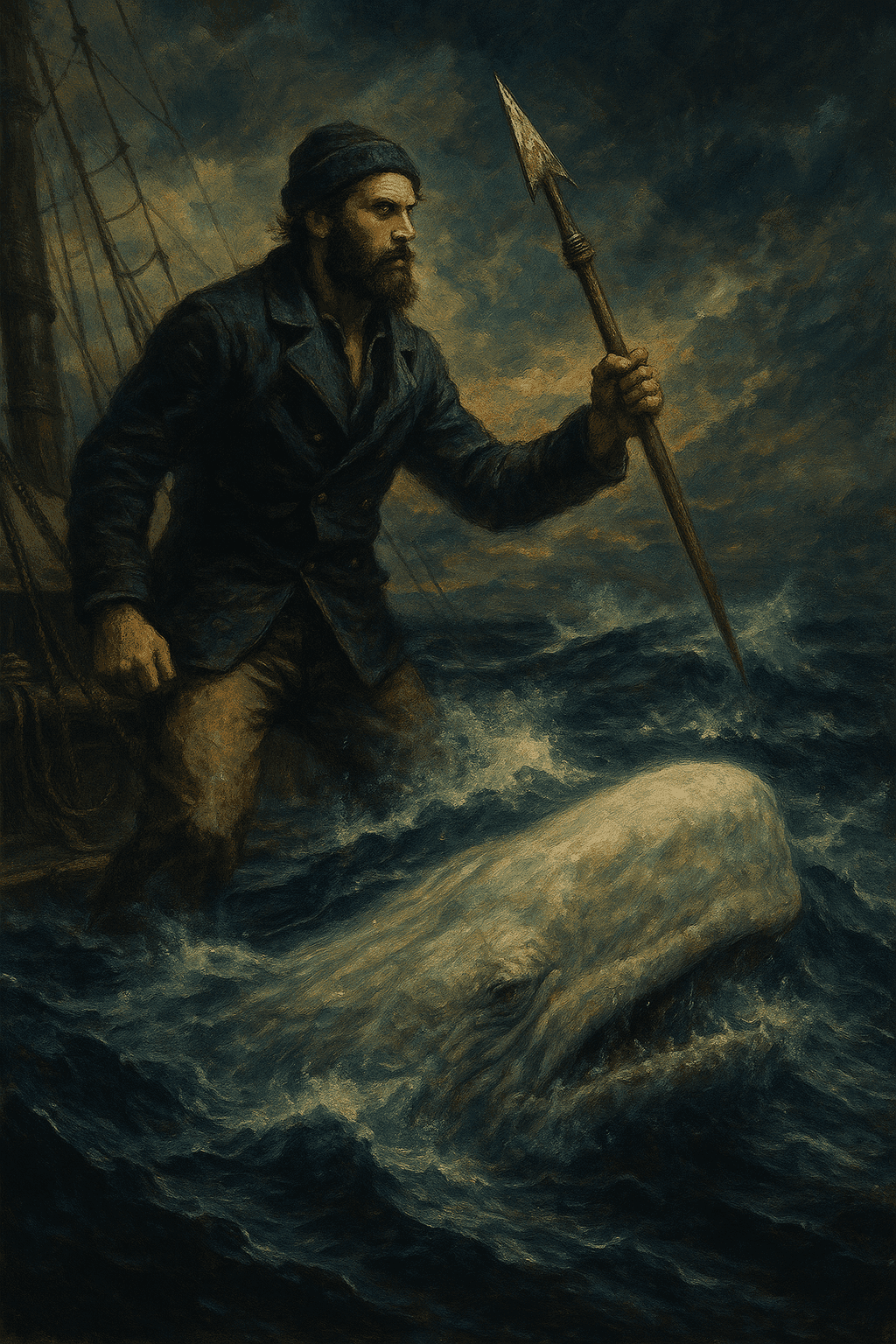
When Herman Melville's Moby-Dick was published in the United States on November 14, 1851, it was far from the instant success we might expect of a classic. Critics were bewildered by its vast scope, its strange mixture of whaling detail and philosophical depth, and its unrelenting portrayal of obsession. Melville's tale of Captain Ahab's pursuit of the white whale defied the neat conventions of adventure fiction and instead plunged into the murky waters of morality, madness, and meaning itself.
Over time, Moby-Dick became a mirror for humanity's greatest struggles—our need to understand the unknowable, our drive to conquer nature, and the cost of our own ambition. Rediscovered long after Melville's death, the novel rose from obscurity to become one of the cornerstones of American literature. Today, Ahab's doomed voyage stands as a symbol of creative daring and the perilous beauty of chasing an impossible dream.
Around the World in Truth
Thirty-eight years later, on November 14, 1889, a young journalist named Nellie Bly stood on a New York pier, ready to turn fiction into fact. Inspired by Jules Verne's Around the World in Eighty Days, Bly set out to circle the globe in record time—with only a small handbag, a notebook, and an iron will. Her editors at the New York World doubted her; so did many men of her era, who claimed such a journey was "unfit for a woman." But Bly's courage and efficiency quickly silenced the skeptics.
She raced through England, across the Suez, into Asia, and across the Pacific, turning her trip into front-page news that captivated millions. When she returned to New York just 72 days later, she shattered Verne's fictional record and redefined what women—and journalists—could accomplish. Bly's voyage wasn't just a triumph of logistics; it was a statement of independence and intellect, a declaration that adventure and ambition belonged to everyone.

The Second Step on the Moon
Eighty years after Melville's whaling voyage and a century after Bly's circumnavigation, humanity set its sights even higher. On November 14, 1969, NASA launched Apollo 12—the second mission to land humans on the Moon. Moments after liftoff, the Saturn V rocket was struck twice by lightning, briefly knocking out its instruments. But the crew, led by Commander Pete Conrad and lunar module pilot Alan Bean, refused to abort. With calm professionalism, they restored power and pressed onward, embodying the resilience that defined the Apollo era.
Their mission succeeded with extraordinary precision: the Intrepid lunar module touched down within walking distance of a robotic probe launched years earlier, marking one of the most accurate landings in space history. The astronauts collected rock samples, set up experiments, and brought back vivid color photographs that revealed the Moon in new detail. Apollo 12 may not have captured the same global attention as Apollo 11, but it quietly proved something just as profound—that space exploration was no longer just a dream, but a discipline.